
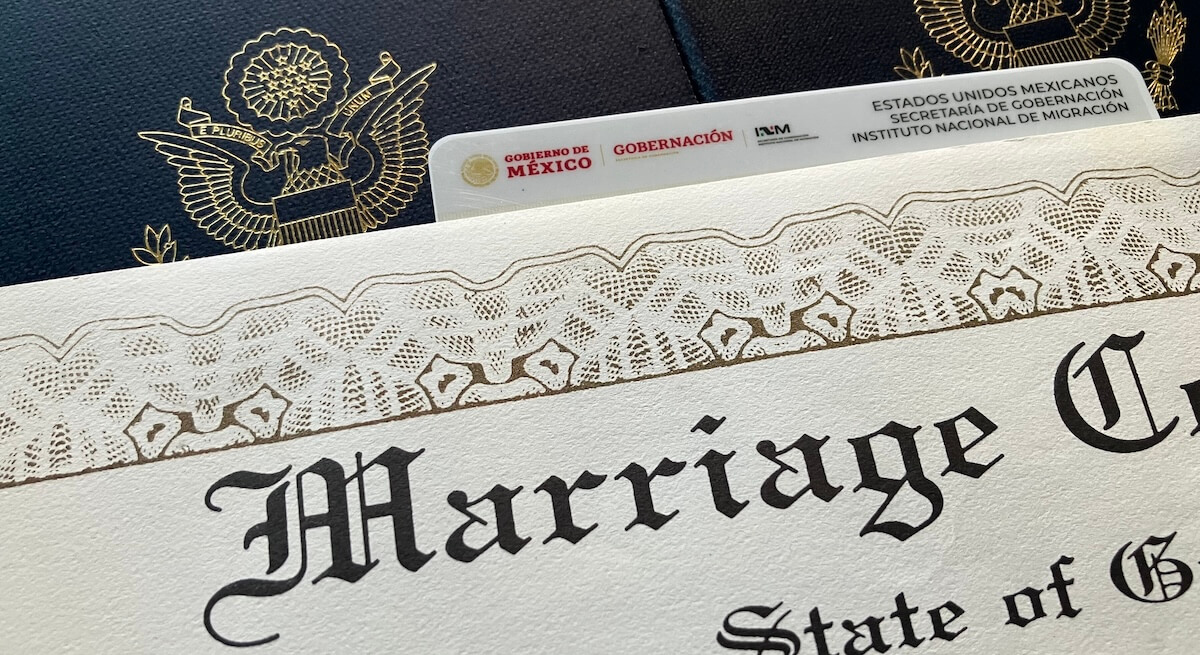
Temporary residency in Mexico through family unity is a pathway for foreigners with close familial ties to Mexican citizens or legal residents. This process can be initiated at either a Mexican consulate outside of Mexico or at an Instituto Nacional de Migración (INM) office inside Mexico.
Temporary Residency via Family Unity
Temporary residency via family unity allows qualified applicants to reside legally in Mexico for up to 4 years, followed by the option to convert to permanent residency. It is an ideal choice for those with immediate family connections in Mexico who plan to live, work, or study in the country.
Step-by-Step Process at a Mexican Consulate
Start the process at a Mexican consulate and finalize residency at an INM office in Mexico. This will require extra steps as opposed to initiating the application at an INM office within Mexico. Some important things to consider:
-
- Some consulates require proof of financial solvency, even if you’re applying via family unity. These thresholds are generally lower compared to regular financial requirements for individuals.
- If financial solvency is required, please note that financial requirements are not uniform among the various consulates. As such, contacting the consulate you intend on using for specific requirements and details is crucial.
Part A – Start at Mexican Consulate: You will initiate the process at a Mexican consulate outside of Mexico.
Step 1 – Review Eligibility Criteria: You may qualify for temporary residency through family unity if you are:
-
- Parents of temporary residents.
- A spouse or common law spouse/partner of a Mexican citizen, temporary resident, or permanent resident.
- Unmarried children of temporary residents under the age of 18 years old, unless they are under guardianship, conservatorship or custody.
- Unmarried children of the spouse or common law spouse/partner of temporary residents under the age of 18 years old, unless they are under guardianship, conservatorship or custody.
- Other (e.g., guardian of temporary residents).
Step 2 – Gather Required Documents and Copies: You will need to prepare your documents before applying. These include, but not limited to:
-
- Completed application: Complete the application form as indicated on the consulate’s website.
- Valid passport: You will need a valid passport as part of the application process.
- Proof of family relationship: Certified marriage, birth, or adoption certificates and common law documentation proving your familial connection. If necessary, documents must be apostilled and translated, if not issued in the country you’re applying.
- Proof of citizenship or residency for sponsoring individual: The Mexican citizen’s INE card (or passport, driver’s license, etc.) or the resident’s valid residency card.
- Financial statements (if applicable): Proof of financial solvency (such as bank/investment statements, social security statements, pension records, proof of employment income, etc.). In some cases, the consulate may require that these be certified and stamped by the respective financial institution.
- Photos: One photo in color, no glasses, frontal view, face uncovered and white background. Verify photo dimensions with the consulate since dimensions may vary by country.
- Payment: Applicable application fee is paid on-site at the consulate.
Make sure that all documents are up-to-date and that you have both originals and copies. Before your appointment, verify with the consulate all the required documentation. Though immigration procedures have increasingly become more standardized, nuances in the required documentation may still exist from consulate to consulate.
Step 3 – Schedule Consulate Appointment: Unless walk-ins are welcome (as in years past) at the consulate you intend on using, you will need to schedule an appointment for your consular interview. This can typically be done via the consulate’s e-mail address, consulate’s phone number, central consulate WhatsApp number for the U.S. and Canada, or through the central online consulate scheduling portal.
Step 4 – Attend Consulate Appointment: The next step is to visit the consulate to submit your application and supporting documentation. The consular agent will ask you about your reasons for seeking temporary residency, your plans in Mexico, and will check and verify your documents.
Step 5 – Provide Payment: Payment of the application fee can be done at the consulate during your appointment. You will need to verify in advance what forms of payment are accepted.
Step 6 – Processing Time: If your application is successful, the consulate will issue you a one-time visa sticker in your passport, which is valid for 6 months. The processing time varies depending on the consulates. Lots of consulates will issue the visa on the same day but some may take days or even potentially weeks.
Step 7 – Collect Passport: If the visa is not issued the day of your interview, you will need to return to the consulate as instructed by the consular agent to collect your passport with the visa sticker. This visa allows you to enter Mexico for the sole purpose of finalizing your residency. If you let the visa expire, you will need to start the process all over again. As such, plan your application and move to Mexico accordingly.
Part B – Finalize Residency at INM Office: You will finalize your residency at an INM office inside of Mexico.
Once you arrive in Mexico, you have 30 days to initiate (not complete) the finalization of your temporary residency with INM, which will result in the issuance of your physical temporary resident card. This is referred to as the canje tramite (exchange process). It is highly recommended that you start this process as soon as feasibly possible once you enter the country. Do not wait until the last minute.
Step 8 – Obtain FMM: When you enter via air or land, you will need to get a FMM marked “CANJE”, which translates to exchange. This will be needed to finalize your residency at your local INM office. Be sure to show the INM agent at immigration the visa sticker in your passport and mention canje. They will know exactly what to do.
-
- By Air: The INM agent will stamp the visa sticker in your passport and mark it with canje and 30 days. Additionally, you might be issued a receipt with a QR code (depending on the airport), that you’ll need to scan and physically print off your FMMd (digital FMM), which will be needed at the INM office to complete the process. If you do not receive any type of scannable receipt, you can also access the online FMM portal and enter information from your passport to generate your FMMd, which you can print. If you enter an airport with automatic passport scanners, do NOT proceed forward through the scanners since these are meant for tourists and will potentially invalidate your temporary residency. If there is a separate national’s line, it is recommended that you use that instead of queuing up in the tourist line. Otherwise, try and find an airline or airport employee who can direct you towards an actual INM agent who can process your canje correctly. Please note that some airports (e.g., BJX, QRO, etc.) may still issue you a paper FMM for your canje.
- By Land: The INM agent should issue you a paper FMM marked canje, which is valid for 30 days, and will stamp the visa sticker in your passport. They may also mark the visa sticker with canje and 30 days as well. Like already mentioned, the FMM will be needed at the INM office to finish the process and finalize your temporary residency. Paper FMMs are still being used at the majority of land border crossings. There is a slightly different process if you are entering by foot at the CBX bridge in Tijuana. If you are entering with a vehicle, you will also need to get a temporary import permit (TIP) for your vehicle, which will be issued for 30 days to match your FMM. Once you have initiated/completed the temporary residency process at the INM office, you will need to visit an aduanas (customs) office to extend your TIP to match the validity of your temporary residency.
- Tip: Please note, if you are unable to download your FMMd or were not issued a paper FMM for whatever reason, at a minimum, ensure that the INM agent has stamped your visa sticker and marked it with canje and 30 days. Additionally, it would be advisable to contact INM’s help desk at [email protected] (if an airport was your point of entry) or [email protected] (if a land border crossing was your port of entry) for further guidance since the FMM is a listed requirement.
Step 9 – Gather Required Documents and Copies: You will need to prepare your documents before applying to finalize your temporary residency. These include, but not limited to:
-
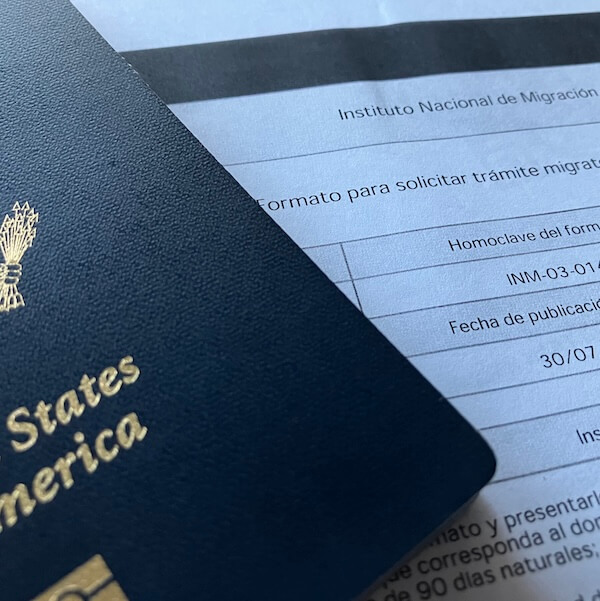
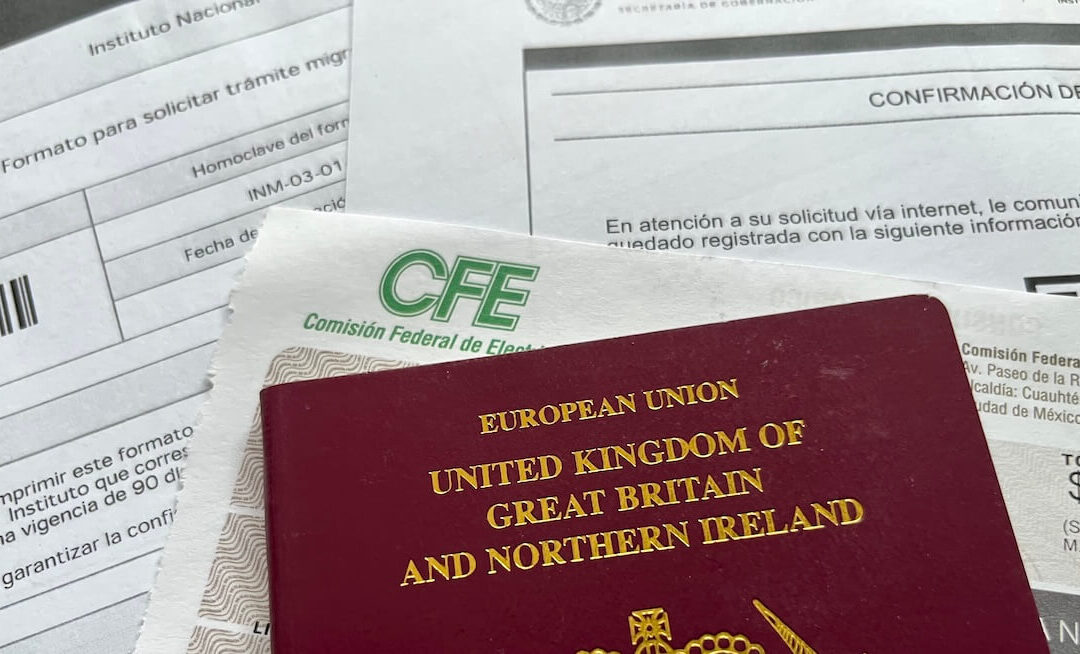
- Completed application form: Complete the Formato Para Solicitar Trámite Migratorio de Estancia form and this can be completed online at INM’s website. This general application form is used for the majority of immigration processes/procedures with INM.
- Completed basic format form: Complete the formato basico form and this can be completed online at INM’s website. This is a general form requesting personal details about yourself.
- Valid passport: You will need your passport with the visa sticker (issued at the consulate) as part of the application process.
- FMM: You will need the FMM marked canje that you received either at the airport or border crossing.
- Letter: This is a letter in Spanish requesting a canje in order to complete and finalize your residency. Though this is not a listed requirement, it is advisable to go ahead and generate this since lots of INM offices will require this like with other trámites that require a letter.
- Proof of address: Though this is not a listed requirement, it is advisable to go ahead and bring this with you since some INM offices may request it. The majority of people will use a utility bill such as a CFE bill. The bill does not need to be in your name.
- Appointment confirmation: You will need the appointment confirmation with the QR code you receive when you schedule your appointment online (see below).
- Biometrics: Photos and fingerprints for residency cards are taken on-site at INM offices.
- Payment: Applicable payment fees are paid on-site at INM offices.
Make sure that all documents are up-to-date and that you have both originals and copies. Before your appointment, verify with your local INM office all the required documentation. Though immigration procedures have increasingly become more standardized across the entire country, nuances in the required documentation may still exist from office to office.
Step 10 – Schedule INM Appointment (If Applicable): Please note that some INM offices are still walk-in only and not in the online appointment system. Otherwise, you will need to schedule an appointment first before proceeding to the INM office with your application and supporting documentation. You can typically see approximately 3 weeks out on the calendar. This can be done on INM’s online appointment portal. You will need to create a free user account and you will also need your “pieza” number, which will be included on your completed formato para solicitar trámite migratorio de estancia application from above.
Step 11 – Attend INM Appointment: The next step is to visit the INM office to submit your application and supporting documentation for finalizing your temporary residency. Again, be sure to book your appointment in advance. You must:
-
- Present your application: You will need to submit your completed application form along with all the supporting documents listed above.
- Provide biometrics: During your appointment, you will be asked to have your fingerprints and photograph taken, which will be used for your residency card.
Step 12 – Provide Payment: Payment of fees can be made with a debit or credit card at the office during your appointment. Cash is not accepted. Currently, there is 1 fee associated with this procedure and this is subject to change:
-
- 1 year temporary resident card fee: $11,141 MXN.
- 2 years temporary resident card fee: $16,693 MXN.
- 3 years temporary resident card fee: $21,143 MXN.
- 4 years temporary resident card fee: $25,058 MXN.
These fees reflect the increases that went into effect on January 1, 2026. Check back on INM’s website regularly as these fees are subject to change at any time and are typically updated once a year. Based on historical data, these fees have been steadily increasing over the years.
Step 13 – Processing Time: The processing time varies depending on the office. While a number of offices are able to complete the process the same day, this is not guaranteed. In practice, the process can sometimes take upwards of 2 to 3 weeks to complete and finalize. INM offices technically have up to 20 business days to finalize most processes, so it is advisable to allow yourself as much time as possible. It is also not atypical to submit your paperwork and make payment at your initial appointment and then return on a subsequent visit to complete your biometrics and card printing. Keep in mind that these immigration processes are designed for people who are living in or have relocated to Mexico, not necessarily for someone flying in for a short stay with the expectation of completing the process and returning home on a fixed timeline. Flexibility with your travel plans is strongly encouraged.
You will receive a document from INM as proof of your application, which will contain a pieza and NUT (número único de trámite) number, in addition to an e-mail. The e-mail will contain a pieza number, password, and an online process tracking link where you can check the status of your application.
Step 14 – Collect Card: As noted above, cards are sometimes issued the same day at the conclusion of your appointment, but this is not always the case. Delays can occur due to technical issues with the biometrics equipment and/or card printing machine, or due to work backlogs at a particular office. If you do not receive your card the same day, monitor the status of your application online, as checking the portal directly is generally the most reliable option since automated notification e-mails are not always sent. You will receive a notification in the form of an oficio, which will be issued in the online portal referenced in the previous step. This is typically the only document that will be issued online and it serves a dual purpose. If you did not receive your card the same day, it is your notification to return to the office to complete any remaining steps, such as biometrics and card printing. If your card was already issued on the day of your appointment, it serves as official confirmation that your canje has been finalized and recorded with INM. Either way, keep this documentation safe as part of your immigration records.
It is worth noting that there are instances where biometrics may be completed on the day of your appointment but the card printer is not working, requiring you to return on a subsequent day to pick up your card. In this scenario, the oficio may have already been issued online the same day of your appointment, which can create some confusion since the oficio would normally be your signal to return to the office. However, once the oficio has been issued, you will typically not receive any additional online notifications indicating when to return to collect your card. In this situation, the best course of action is to ask the INM agent directly when to return, as there may be no further notifications issued online.
Step-by-Step Process at an INM Office
If you are already in Mexico, you can apply directly at an INM office. The following is a step-by-step explanation of the process and requirements (link to INM website). Some important things to consider:
-
- Unlike consulate applications, financial solvency is typically not required for applications completed within Mexico under family unity.
- You must have entered Mexico legally, with a tourist FMM (Forma Migratoria Múltiple) or other valid migratory document, e.g., temporary student resident card.
Step 1 – Gather Required Documents and Copies: You will need to prepare your documents before applying for temporary residency. These include, but not limited to:
-
- Completed application form: Complete the Formato Para Solicitar Trámite Migratorio de Estancia form and this can be completed online at INM’s website.This general application form is used for the majority of immigration processes/procedures with INM.
- Valid passport: You will need a valid passport as part of the application process.
- Letter: This is a letter requesting a change to your immigration status to a temporary resident via family unity. This letter can be completed and generated on INM’s website (in the requirements section).
- FMM: You will need the the tourist FMM that you received either at the airport or border crossing. See above for how to access and print your FMMd from INM’s online FMM portal.
- Proof of family relationship: Certified marriage, birth, or adoption certificates and common law documentation proving your familial connection. If necessary, documents must be apostilled and translated into Spanish, if not issued in Mexico.
- Proof of citizenship or residency for sponsoring individual: The Mexican citizen’s INE card (or passport, driver’s license, etc.) or the resident’s valid residency card.
- Completed basic format form: Though this is not a listed requirement, this may be requested at some INM offices. As such, it is advisable to complete the formato basico form and this can be downloaded online from INM’s website. This is a general form requesting personal details about yourself, which is used for statistical purposes.
- Proof of address: Though this is not a listed requirement, it is advisable to go ahead and bring this with you since some INM offices may request it. The majority of people will use a utility bill such as a CFE bill. The bill does not need to be in your name.
- Appointment confirmation: You will need the appointment confirmation with the QR code you receive when you schedule your appointment online.
- Photos: Photos for temporary residency cards are taken on-site at INM offices.
- Payment: Applicable payment fees are paid on-site at INM offices.
Make sure that all documents are up-to-date and that you have both originals and copies. Before your appointment, verify with the consulate or INM office all the required documentation. Though immigration procedures have increasingly become more standardized, nuances in the required documentation may still exist from location to location.
Step 3 – Schedule INM Appointment: Same process as outlined above.
Step 4 – Attend INM Appointment: Same process as outlined above.
Step 5 – Provide Payment: Payment of fees can be made with a debit or credit card at the office during your appointment. Cash is not accepted. Currently, there are 2 fees associated with this procedure and this is subject to change:
-
- Application fee: $1,847 MXN.
- 1 year temporary resident card fee: $11,141 MXN.
- 2 years temporary resident card fee: $16,693 MXN.
- 3 years temporary resident card fee: $21,143 MXN
- 4 years temporary resident card fee: $25,058 MXN.
These fees reflect the increases that went into effect on January 1, 2026. Check back on INM’s website regularly as these fees are subject to change at any time and are typically updated once a year. Based on historical data, these fees have been steadily increasing over the years.
Step 6 – Processing Time: If you initiate the family unity process from within Mexico at an INM office, be aware that all offices are now scrutinizing these applications more closely, which can significantly extend the processing time. In some cases, taking well beyond a couple of months and upwards of 6 months. In contrast, starting the process at a Mexican consulate outside of Mexico may be more efficient (but not guaranteed), since the consulate verifies your documents during your appointment. Once you enter Mexico with your visa, you’ll only need to complete the canje (exchange) process, which is often faster because the documentation has already been reviewed and verified.
Step 7 – Collect Card: Same process as outlined above.
Advantages of Temporary Residency via Family Unity
-
- Typically issued for 1 year if applying at a consulate and 2 years if applying at an INM office. After 2 years of temporary residency, one can apply to convert to permanent residency.
- Access to healthcare, education, and employment opportunities.
- No financial solvency required for INM-based applications.
- Pathway to permanent residency or citizenship in the future.
Tips for a Smooth Application Process
-
- Research local requirements: Financial solvency rules and required documentation may vary by consulate or INM office.
- Plan your entry: If applying through an INM office, ensure your entry to Mexico is legal and documented.
- Be prepared for delays: Keep extra copies of documents and allow for processing delays when scheduling appointments.
Frequently Asked Questions
Q: Can I apply for temporary residency via family unity if I’m already in Mexico?
A: Yes, you can apply for temporary residency via family unity at an INM office in Mexico. However, you must have entered Mexico legally with a valid FMM or migratory document.
Q: Do I need to prove financial solvency for this process?
A: If applying at a Mexican consulate abroad, some consulates may require proof of financial solvency, though the thresholds are generally lower compared to the normal financial requirements for an individual. If applying at an INM office in Mexico, proving financial solvency is not a requirement.
Q: How long is temporary residency valid?
A: Temporary residency is valid for 1 to 4 years, depending on your application (e.g., legal status of sponsoring individual). You have the option to convert to permanent residency after completing your temporary residency.
Q: Can I work in Mexico with a temporary residency card?
A: Yes, temporary residency allows you to work in Mexico. However, you will need to apply separately with INM for work authorization.
Q: What happens if I don’t complete the process after entering Mexico with a consulate-issued visa?
A: If you fail to initiate the finalization of your residency application within 30 days of entering Mexico, the process will be invalidated, and will need to start the process over again at a consulate.
Helpful Online Resources
Stay up-to-date on all relevant information in regards to INM as it relates to immigration matters, as outlined in this article, by checking the following websites:
-
- Gob.mx: Mexico’s official federal government portal with details on all government matters, including providing detailed information on immigration and more.
- INM: Mexico’s official federal government agency responsible for all matters related to immigration.
- INM micro website: Official website of INM where you can complete all immigration procedures/processes (trámites), schedule an appointment and more.
- SAT: Mexico’s official federal government agency responsible for the collection of taxes from individuals and businesses.
Conclusion
Temporary residency via family unity is an accessible and straightforward pathway to legally live in Mexico for up to 4 years, offering flexibility for families with immediate connections in the country. With benefits including access to healthcare, education, and employment opportunities, this option is ideal for those who plan to settle temporarily while exploring long-term opportunities like permanent residency or citizenship. By carefully preparing your application and staying informed about consulate or INM requirements, you can ensure a smooth process and focus on building your life in Mexico.
Please feel free to leave us a comment below about your personal experience of obtaining temporary residency via family unity. We would love to hear from you! Additionally, if you found this article helpful, consider sharing it with others who might benefit from it. A quick share goes a long way in helping others discover useful information!



0 Comments